GEO
What Should a GEO Agency Actually Do for Your Business?
What should your GEO agency actually change? A practical guide to setup, ongoing work, useful reports and the questions to ask before hiring a team.
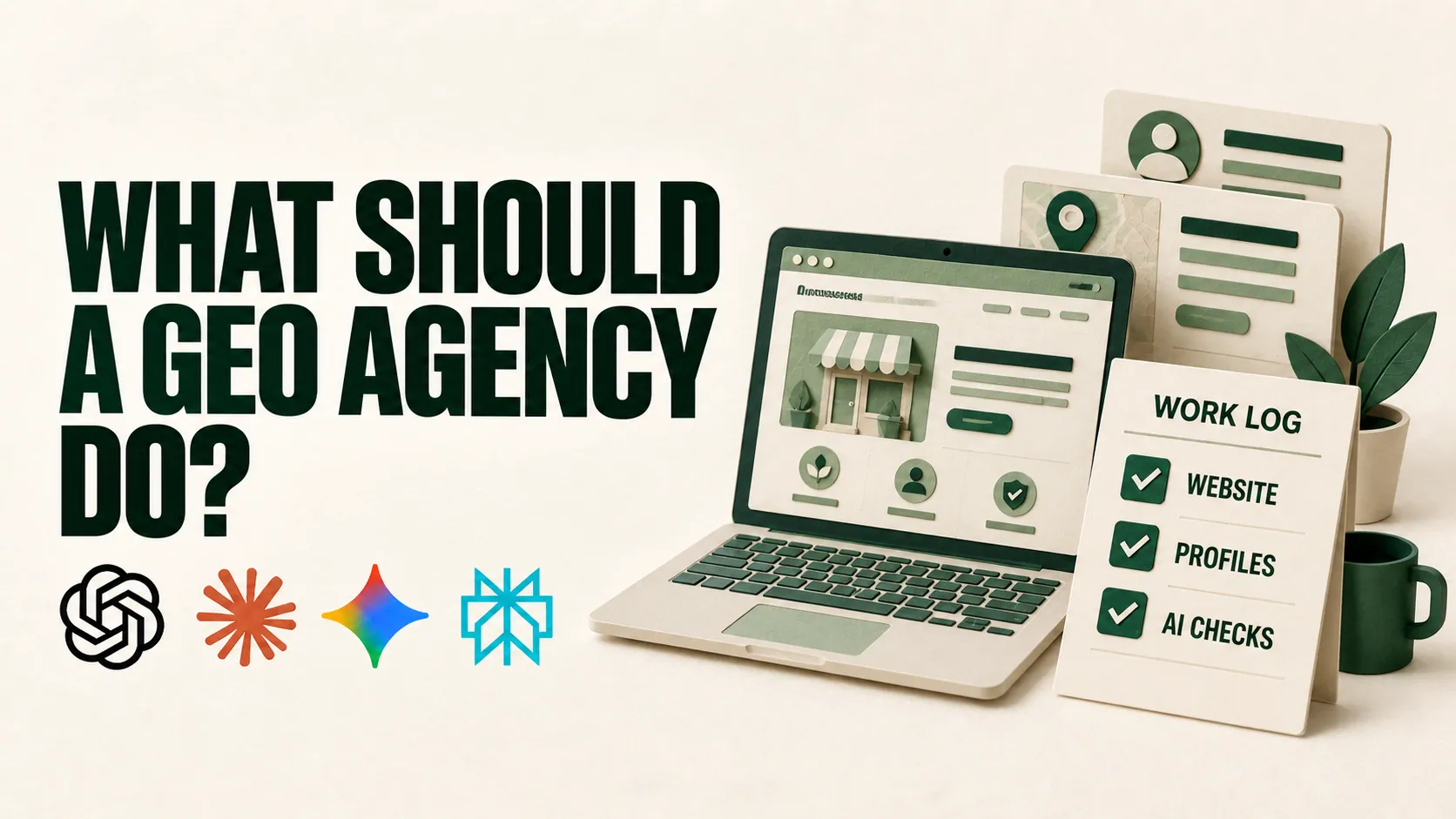
You've had the audit. Thirty findings, a traffic light beside each one, and a note to "fix critical items first." You're still left wondering who fixes them and what next month's fee will cover.
A GEO agency should explain what it will change, make the agreed changes, and show you the work. For a local business, that usually means preparing the website for AI search, improving service and location information, correcting relevant business profiles, and keeping those details useful and current. Ongoing work should include research, implementation and checks you can understand.
GEO stands for generative engine optimization: work intended to help a business appear in AI-generated answers. Our guide to GEO, AEO and local SEO explains how the terms fit together. When you're choosing help, the more useful question is what someone will actually do for you.
What can a GEO agency realistically promise?
An agency can commit to specific work on the pages and profiles you authorize it to manage. It can research opportunities, request corrections elsewhere and check how your business appears. The assistant decides which businesses to recommend.
That distinction matters when you're reading a proposal. A rewritten service page is a completed task. A call from someone who found you through ChatGPT is an outcome. You want to see both, with enough detail to understand what happened.
OpenAI says ChatGPT can search the web and use other search providers, but placement isn't guaranteed. Google similarly warns against guaranteed rankings.
An audit can be useful on its own, especially when you have a developer ready to implement it. Just make sure the price and scope match what you're buying. A managed service should name who does the work, who checks it and what needs your involvement.
What should happen during setup?
The first stage should establish what needs fixing and leave you with agreed changes that have been checked. The exact tasks depend on your website, existing profiles and access. Ask the agency which of these areas it will cover.
Can search systems reach and read your pages?
Someone should inspect crawl rules, hosting protections and the actual content a crawler receives. Your service details need to be available as readable text.
For ChatGPT search eligibility, OpenAI says to allow OAI-SearchBot and its published network addresses. Its crawler documentation distinguishes that search bot from GPTBot, which is used for training. Blocking the search bot doesn't prevent every possible mention of your business elsewhere; OpenAI also describes an exception for navigational links.
For Google's AI Overviews and AI Mode, a supporting page must be indexed and eligible for a search snippet. The agency should also check your Search generative AI setting in Search Console, including any exclusion inherited from a parent property.
Ask for evidence of the specific problem and the change made. Removing a firewall restriction can restore access. It doesn't prove that an assistant will recommend you.
Does your website explain what customers need to know?
A visitor should be able to find what you do, where you work, how to request a quote or book, and what makes your service a suitable choice.
Some services deserve their own page because customers need different information about each one. A heat pump installation page, for example, might explain the systems you install, the assessment process and the towns you cover. That decision should come from what the customer needs, not a target number of pages.
The work may also include internal links and accurate LocalBusiness structured data. The markup should reflect the business information visitors can actually see.
Google says it doesn't require special AI schema or an llms.txt file for its generative search features. Those items shouldn't be presented as a shortcut to Google recommendations.
Are the right business profiles accurate?
Start with the profiles customers and relevant search systems use. For an eligible local business, Google Business Profile deserves attention. Bing Places, Yelp, industry directories and supplier listings may also matter, depending on your trade and market. Microsoft specifically recommends keeping Bing Places information current for local business information.
Check names, phone numbers, hours, services and locations. Aim for accurate facts across each platform. A business that travels to customers should follow Google's service-area rules, rather than publish a private home address just to make every listing look identical.
Some corrections take time because you don't control the listing. The work log should show which details were fixed and which requests are still waiting on someone else.
What does the starting picture look like?
Before making changes, save a small set of realistic customer questions and the answers they produce. Record the date, assistant, search mode, location context, businesses named and sources shown.
Use the same questions and comparable conditions for later checks. Keep ordinary search and enquiry data too. Our guide to investigating missing ChatGPT recommendations walks through this process.
These checks are snapshots. They help you investigate changes, but they don't represent every answer every customer receives.
What should the agency do each month?
Monthly work should respond to real questions, gaps and changes in your business. Ask how the team chooses its priorities.
Research customer questions. Calls, quote requests, Search Console queries and public discussions can reveal what people need help choosing. Questions suggested from your website can help too, as long as they're described as suggestions rather than recorded searches.
Improve pages and profiles. New services, changed hours, an unclear booking process or an outdated supplier listing give the team something concrete to work on. Your agency should keep an agreed set of sources current and record problems it needs others to resolve.
Contribute useful information where it belongs. There may be a local guide, industry directory or public discussion where your business has relevant knowledge. Contributions should answer the question, use supportable facts and follow the destination's rules. Someone working for your business should make that relationship clear. A genuine customer's experience mustn't become a made-up independent endorsement.
Ask to see examples of this work. Google's spam policies cover manipulative links and scaled content abuse. Its AI guidance also cautions against inauthentic mentions.
Review work deserves particular care. The FTC's consumer review rule, effective October 21, 2024, addresses fake reviews and incentives conditioned on a positive or negative sentiment. Platform policies can be stricter: Google prohibits review incentives. A useful contribution from your agency is separate from a customer review.
Check progress and plan the next work. Repeat the agreed question checks, inspect sources and report what changed. As of September 2026, Google's generative AI performance report reports impressions for AI Overviews and AI Mode. The report may be absent when a site hasn't received enough impressions. Bing Webmaster Tools provides citation reporting for Microsoft's AI experiences. Neither report measures your visibility across every assistant.
Track visits, calls and bookings where you can. Some customers won't tell you how they found you, and one increase doesn't establish which edit caused it. A useful report explains those limits.
What should a monthly work log show?
You should be able to open it and find the work without decoding a dashboard.
| Entry | What you should see |
|---|---|
| Date and task | When the work happened and what changed |
| Location | The affected page, profile or public contribution |
| Reason | The customer question or evidence behind the priority |
| Evidence | A live link, screenshot or before-and-after record |
| Check | What was verified, such as a corrected phone number or restored crawler access |
| Next step | The follow-up task, person responsible and any dependency |
Keep completed work, observed AI answers and business results easy to distinguish. A visibility score needs an explanation of which questions, platforms and checks produced it.
Unfinished work belongs in the log too. "Profile correction submitted; awaiting verification" tells you more than quietly leaving the task out.
What could a month of work look like?
Imagine a small heating and air conditioning business in Boise. This business and the following schedule are hypothetical. They're an example of how work might be organized, not a customer story, a promised delivery schedule or measured results.
Week one: The owner provides account access, service details and the jobs they want more of. The agency records answers to 12 customer questions across ChatGPT and Google's AI Mode, noting the settings and sources. It investigates a crawler-access problem and checks the main pages' indexing status.
Week two: The team improves the heat pump installation page with the company's actual service areas, equipment details and quoting process. It adds a useful internal link and corrects outdated information on relevant profiles.
Week three: A recurring question about rebates becomes a research task. The team checks the current rebate provider's guidance and helps explain the application steps. Where a relevant public discussion permits business participation, it can contribute a sourced answer with its relationship disclosed. It also follows up on an incorrect supplier listing.
Week four: The agency repeats the question checks under comparable conditions and records what it observes. The owner receives links to completed changes, outstanding tasks and the next priorities. Available search data and enquiries are included, with gaps explained.
The example doesn't assume that AI recommendations or traffic improved that month. You can still assess whether the agreed work was useful, completed and checked.
How much will you need to do?
You bring the business knowledge. The team needs enough access and accurate material to work with it.
- Accounts: Website, relevant profiles and search tools. For an initial audit, Google recommends read-only Search Console access. Agree any broader permissions when implementation starts.
- Facts: Services, areas, hours, qualifications and what you don't offer.
- Priorities: The jobs you want more of and customers you can realistically serve.
- Material: Photos of actual work and information the team has permission to use.
- Answers: A kickoff conversation and occasional clarification when a detail needs your knowledge.
Ask how much routine involvement the service expects from you. Having to clarify a service detail is reasonable. Managing every task yourself may defeat the reason you hired help.
What should you ask before signing?
Take these questions into the conversation:
- Who will make the website and profile changes? Does my developer need to be involved?
- What is included in setup, and how will we agree priorities?
- Can I see an example work log with evidence of completed changes?
- Which assistants and questions will you check, under what conditions and how often?
- What costs extra? Ask specifically about rebuilds, advertising and finished blog articles.
- Will I retain control of my accounts and receive the work records when we stop?
- What results are you aiming for, and which parts can you actually commit to?
A clear answer can include limits. Waiting for a listing provider or needing your developer's help is normal. Those dependencies should be explained before they become a surprise.
A few other questions worth asking
Does a GEO service write every blog post?
It depends on the agreement. Citywise AI's blog support includes questions, topics and writing outlines for your business to use. Full blog production shouldn't be assumed from a proposal that only says "content." Ask who researches, writes, checks and publishes each type of work.
Do you need a separate GEO agency when you already pay for SEO?
Possibly not. Much of the website and profile work overlaps with technical and local SEO. Ask your existing agency whether it checks AI answers and cited sources, includes relevant crawler access, and handles the changes you need. Compare the actual scope before paying two teams for the same work.
Can you do this yourself?
Yes, particularly with a small website and a manageable set of profiles. Start with accurate service information and a few customer-question checks. Bring in help for work you can't implement or maintain. The ongoing time commitment often matters as much as the initial checklist.
Start with the scope of work
Ask your current or prospective agency for a sample work log and a written implementation scope. You should come away knowing what will change, who is responsible and how you'll review progress.
Citywise AI's City Partner service starts with technical setup and website optimization, then covers relevant business profiles and ongoing research, referenced contributions, AI checks and monthly reporting. We agree the scope before work starts. Blog questions and writing outlines are included; website rebuilds and advertising are separate. The service page explains the current price and eligibility.
You can also start with the free question finder. Enter your website, choose a few suggested questions and try them in your own AI assistant. That gives you a concrete starting point for deciding what to handle yourself and where you'd like a team to help.